The world is in constant update in the realm of technological advancements that try to make society easier and more efficient. One of those advancements is facial recognition, particularly with the launch of the database that has the facial recognition of a large portion of the population for a first of its kind criminal database (Interpol). However, is there a lack of consideration for concerns coming from minority groups and is this new technology leaving them out or worse discriminating against them. With this form of advancement being in its infancy, it had a hard time recognizing plastic surgery, cosmetics, and people of color.
Since its inception, facial recognition has been trying to find its way into law enforcement to find suspects much faster. In turn, facial recognition has already been falsifying charges onto people based off identification by a facial recognition software that locked a Black father in suburban Detroit (Johnson). It has got to the point where civil right advocates have started protesting the technology for struggling to distinguish darker faces. Their fear is the racial inequity already within policing will only worsen with technology that continues to discriminate against people of color at the law enforcement level (Johnson 2). The writing is already on the wall that this technology can only lead to more racial profiling and false arrests.
The wave has already begun, major cities in the United States have fought against the use of facial recognition within law enforcement. More than a dozen major cities in the U.S. have even gone as far to ban the technology entirely such as Boston, San Francisco, Minneapolis, and the list is only growing from there (Fergus). This goes to show that people are recognizing the bias that facial recognition has on people of color but also citizens are realized how overall it is going against their constitutional rights with collecting this type of data unapproved.
There have been studies done already to prove the racial discrepancy and bias when it comes to facial recognition technology. We know the story of the father in detroit that was locked up for a false identification. A Federal study in 2019 stated that Asian and African Americans were up to 100 times more likely to be misidentified than white faces. Also, Native Americans were had the highest false-positive rate (Harwell). So, the numbers back it up there is a bias with the technology itself and to see law enforcement implement it when there’s already racial inequity within the system. It is no wonder why citizens are asking questions and pushing back.
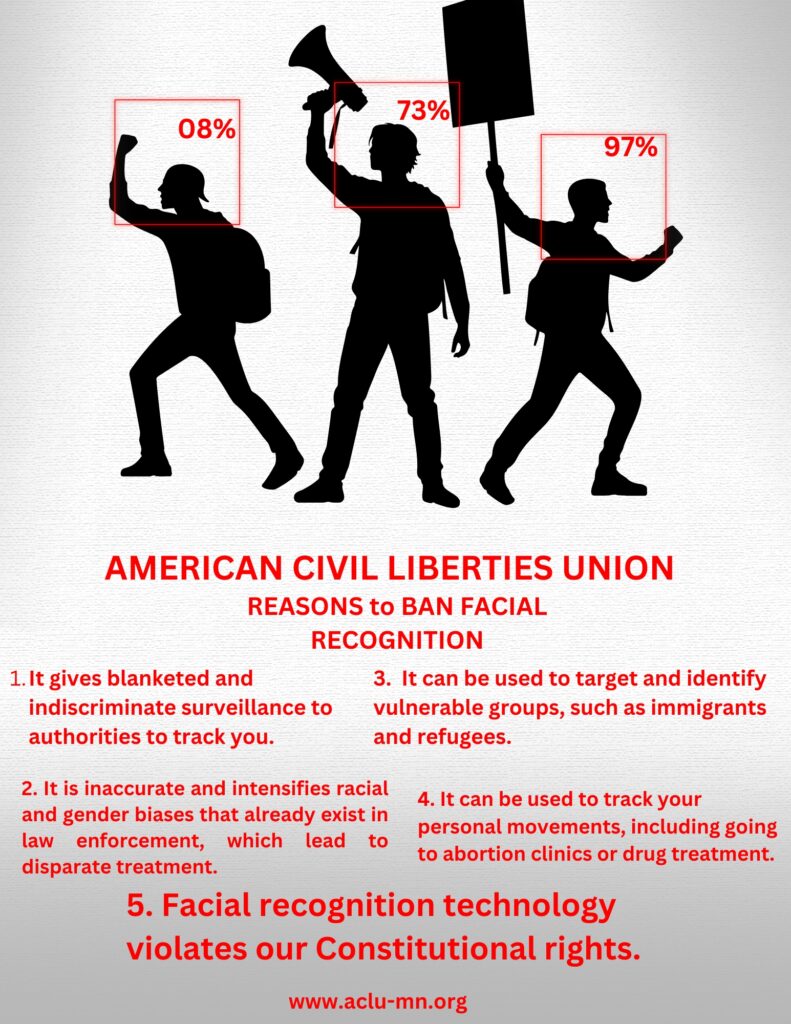
The debate has been ongoing for many years now with not just facial recognition tactics within law enforcement but with surveillance in general. Is it safe? Is it infringing on the rights and privacy of citizens?(Louter). Governments across the globe have already started to take action as well. The European union has drafted a proposal as part of the Artificial Intelligence Act that essentially pushed for a ban on the technology (Lively). However, in the United Kingdom Facial Recognition is being used to replace passports and even provide school lunches. The UK’s stance is more from a perspective of not over-regulating the technology and utilizing it in small portions (Lively 2). This is a topic that can be seen from many different angles with their being benefits but also just concern in the back of your mind of ‘Is this thing looking at my every move?’ even if there’s people who approve of the technology there must be some questions risen or at least a little uneasiness
But what is our part to play in this raging debate? Well, the fight against discrimination from facial recognition has already taken place in the battle of racial inequity within law enforcement. With that so, there is already petitions and activists raising awareness about the use of this technology. It is not just facial recognition but surveillance in general. Is over-surveillance helpful within neighborhoods especially from minority groups who are already discriminated against and see racial inequity, divide, and bias on a daily basis. It is important to be in constant awareness of what our federal and local governments are making decisions on and we need to voice those concerns especially when people are being treated unfairly and infringing on our rights. For me, I am glad that there are concerns being brought up about this topic and how cities and other countries’ governments are acting and recognize the bias of using this technology. Digital inclusion means including everyone and making sure that everyone has a fair shot and a seat at the table.
References:
Fergus, Rachel. “Biased Technology: The Automated Discrimination of Facial Recognition.” ACLU of Minnesota, 29 Feb. 2024, www.aclu-mn.org/en/news/biased-technology-automated-discrimination-facial-recognition.
Harwell, Drew. “Federal Study Confirms Racial Bias of Many Facial-Recognition Systems, Casts Doubt on Their Expanding Use.” The Washington Post, www.washingtonpost.com/technology/2019/12/19/federal-study-confirms-racial-bias-many-facial-recognition-systems-casts-doubt-their-expanding-use/. Accessed 12 Dec. 2024.
Johnson, Thaddeus L., and Natasha N. Johnson. “Police Facial Recognition Technology Can’t Tell Black People Apart.” Scientific American, Scientific American, 20 Feb. 2024, www.scientificamerican.com/article/police-facial-recognition-technology-cant-tell-black-people-apart/.
Lively, Taylor. “Facial Recognition in the US: Privacy Concerns and Legal Developments.” ASIS Homepage, www.asisonline.org/security-management-magazine/monthly-issues/security-technology/archive/2021/december/facial-recognition-in-the-us-privacy-concerns-and-legal-developments/. Accessed 12 Dec. 2024.
Louter, Lysanne. “Racial Bias in Facial Recognition Algorithms.” Amnesty International Canada, 8 June 2023, www.amnesty.ca/features/racial-bias-in-facial-recognition-algorithms/.